news room
Kenya Pasteurization Law Explained: Milk Safety Standards, Legal Requirements, and What Dairy Businesses Must Do
Milk safety is a national public health priority in Kenya. To protect consumers and regulate dairy
trade, Kenya enforces strict laws requiring milk sold to the public to meet defined safety
standards. At the centre of these requirements is mandatory pasteurization, as set out under the
Dairy Industry Act (Cap 336) and the Dairy Industry (Dairy Produce Safety) Regulations,
2021. These laws affect every dairy processor, cooperative, milk trader, and food business
handling milk intended for public sale.
Understanding the Kenya pasteurization law, milk safety standards, and pasteurizer equipment
requirements is essential for any dairy business seeking legal compliance, market access, and
long-term sustainability.
What the Kenya Pasteurization Law Requires
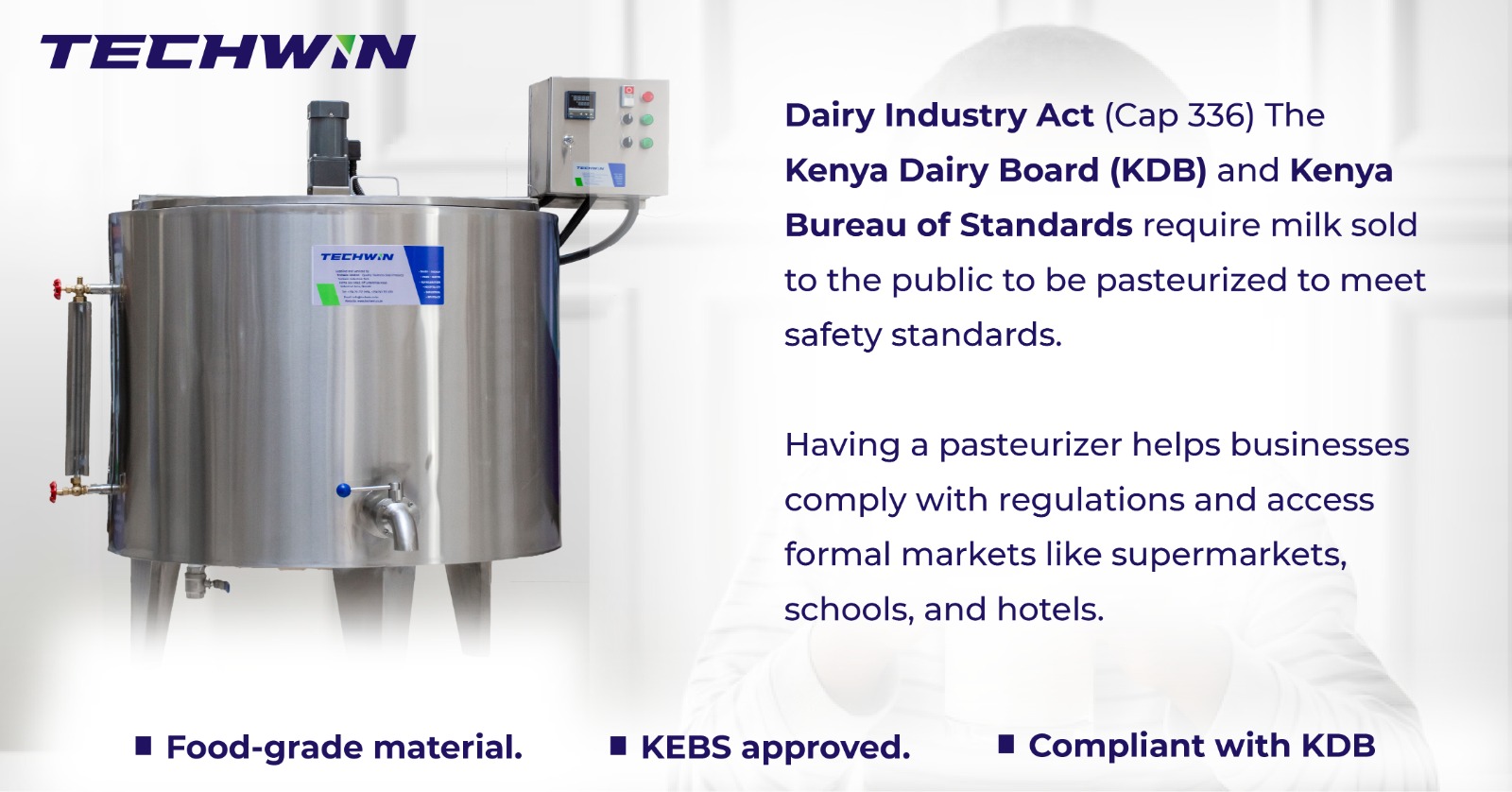
Kenya’s legal framework for milk safety is established under the Dairy Industry Act (Cap
336), with detailed operational requirements outlined in the Dairy Industry (Dairy Produce
Safety) Regulations, 2021. These Regulations define how milk and dairy products must be
processed, handled, tested, stored, and sold to protect public health.
The Regulations require that all milk offered for sale to the public must undergo an approved
safety process, with pasteurization being the most widely accepted and practical method.
Pasteurization involves heating milk to a specific temperature for a defined time to eliminate
harmful microorganisms while preserving nutritional quality.
Under the Regulations, raw or untreated milk is not permitted for public sale in formal
markets unless it has been subjected to approved processing. This means dairy businesses must
integrate pasteurization into their operations to comply with the law.
Regulatory Authorities Enforcing Milk Safety Standards in Kenya
The Kenya Dairy Board (KDB) is the statutory authority mandated to regulate, organise, and
develop the dairy industry. KDB enforces compliance with dairy safety regulations, including
inspection of facilities, licensing of dairy businesses, and monitoring of milk quality across the
value chain.
The Kenya Bureau of Standards (KEBS) complements KDB’s role by developing and
enforcing technical standards under the Standards Act (Cap 496). KEBS standards define
acceptable pasteurization temperatures, microbial limits, hygiene requirements, packaging, and
labelling specifications that dairy products must meet before entering the market.
Together, KDB and KEBS ensure that milk sold in Kenya meets nationally recognised milk
safety standards and protects consumers from foodborne illnesses.
Why Mandatory Pasteurization Is Critical for Public Health and Market Access
Mandatory pasteurization is designed to eliminate disease-causing bacteria such as Salmonella,
E. coli, Listeria, and Brucella, which can be present in raw milk. Without pasteurization, milk
poses significant health risks, especially to children, the elderly, and immunocompromised
individuals.
Beyond health protection, compliance with pasteurization requirements determines market
access. Supermarkets, hotels, schools, hospitals, and institutional buyers require proof that milk
has been processed according to regulatory standards. Pasteurized milk is therefore essential for
dairy businesses seeking to operate in formal and regulated markets.
Adhering to pasteurization laws also enhances consumer confidence, product consistency, shelf
life, and brand credibility in a competitive dairy market.
Penalties for Selling Unpasteurized or Non-Compliant Milk in Kenya
The Dairy Produce Safety Regulations clearly outline penalties for non-compliance. Any person
who processes, handles, or sells milk that does not meet the prescribed safety standards commits
an offence.
Penalties include:
• Fines of up to KES 10,000
• Imprisonment for up to twelve months
• Seizure, condemnation, or destruction of unsafe dairy produce
• Suspension or cancellation of operating licences
These enforcement provisions mean that selling unpasteurized milk exposes dairy businesses to
legal, financial, and reputational risks.
Additional Milk Processing and Handling Requirements
Pasteurization alone is not sufficient without proper handling. The Regulations also require dairy
operators to:
• Test and grade milk before processing
• Maintain hygienic processing environments
• Use food-grade equipment
• Store milk at regulated temperatures after pasteurization
• Maintain records of quality tests and inspections
Failure at any stage of processing or handling can render milk non-compliant, even if
pasteurization has occurred.
What This Means for Dairy Processors and Milk Businesses
For dairy processors, cooperatives, and milk entrepreneurs, compliance begins with appropriate
pasteurizer equipment capable of meeting legal temperature and hygiene requirements
consistently. Manual or informal heating methods often fail to meet regulatory standards and
expose businesses to rejection during inspection or testing.
Modern pasteurizer equipment enables businesses to:
• Meet Kenya pasteurization law requirements
• Improve milk safety and consistency
• Increase shelf life and reduce spoilage
• Access formal and institutional markets
• Protect their business from regulatory penalties
Investing in compliant pasteurization systems is therefore both a legal necessity and a strategic
business decision.
Compliance as a Competitive Advantage in Kenya’s Dairy Industry
Kenya’s mandatory pasteurization requirements are not intended to limit dairy businesses, but to
strengthen the industry through safer products, formal market integration, and consumer trust.
Businesses that comply with the Dairy Industry (Dairy Produce Safety) Regulations, 2021
position themselves for sustainable growth in an increasingly regulated and quality-driven
market.
Understanding the law, implementing compliant processing systems, and aligning operations
with KDB and KEBS standards ensures dairy businesses remain legally protected, competitive,
and ready to serve both local and institutional markets.
Contact us on +254743 793 878 to inquire about milk pasteurizers and processing equipment.
Techwin Completes 50 kVA Solar Plant at Murang’a Technical Training Institute
Renewable Energy for Sustainable Futures: Techwin Limited Supporting the Advancement of Technical Education with Clean Energy.
What Is the Cost of a Milk ATM Machine in 2025 - Call 0743793878
A Complete Milk Dispenser Business Guide for Dairy Enterprises.
Your Guide to Milk Pasteurizer Prices - Call +254743 793 878
Your Guide to Milk Pasteurizer Prices in Kenya. Are you ready to elevate your dairy business or expand your milk business operations in Kenya?

How to Make Yogurt and Mala in Kenya for Better Profits.
Making money from the dairy business through yogurt and mala production. A smart value-added venture for dairy entrepreneurs.
A Comprehensive Guide to Stainless Steel Tanks in Kenya
Are you in the food, beverage, cosmetic, or pharmaceutical industry and looking for high- performance, long-lasting storage and processing solutions?
How to Start a Fruit Juice Plant in Kenya – Full Guide
Are you planning to start a fruit juice processing plant in Kenya? Whether you’re a farmer looking to reduce post-harvest losses, an investor eyeing the booming health
Yogurt Making Equipment for Sale in Kenya
Are you a dairy farmer or business owner in Kenya looking to expand into yogurt production? Whether you're just starting out or adding value to your existing milk
Curbing Post-Harvest Losses with Solar Cold Storage
According to the FAO, around 14% of food is lost globally between harvest and retail, largely due to poor post-harvest handling and inadequate storage. In sub-Saharan
How a Milk ATM Transformed Samuel's Dairy Business in Kenya
In Kenya, dairy farming is a popular and lucrative business. However, many dairy farmers face challenges like milk spoilage, hygiene concerns, and inconsistent
How A Solar Water Heater Transformed Ntwiki’s Home
When Francis Ntwiki from Mwingi in Kitui County, Kenya, faced rising electricity bills, he knew it was time to find a more sustainable, cost-effective solution for heating
Importance of Investing in Dairy Value Addition
Dairy farming plays a crucial role in the agricultural sector, but farmers often face challenges in the value chain, such as milk perishability and fluctuating market prices.
Boost Your Dairy Business Efficiency With Equipment
Starting a dairy business? Techwin offers a wide range of advanced solutions, but here’s a look at the key equipment you need to get started.
Celebrating World Food Day 2024: Dairy Milestones
In our ever-evolving world, each new day presents us with fresh challenges, and the undeniable reality of climate change is no longer
Hybrid Pasteurizers: Increasing Your Dairy Profits
Are you considering upgrading your dairy business by venturing into yogurt production, cheese, mala making, or any other dairy value-added product? Dairy farmers like you often face
- How to Optimize Solar Power for Small-Scale Agricultural Processing
- Boosting Kenya's Dairy Sector: KEPSA SME Conference
- How to Make Your Own Tasty Yogurt at Home - Recipe
- Championing Green Innovations at Dairytech Africa 2024 Conference
- Techwin Empowering Sustainable Dairy Businesses
- Batch Milk Pasteurizers: The Key to Safe and Quality Dairy Products
- Best Milk Cooling Tanks For Sale In Kenya - KEBS Certified
- Transforming Challenges into Opportunities for MSMEs
- Techwin Installs Cold Storage Unit, Slashing Post-Harvest Losses
- Techwin’s Dairy Solutions Featured at the Pre-Madaraka Festival 2024
- Food Safety in the Kenyan Dairy Value Chain
- Are Residential Solar Water Heaters Worth It?
- Benefits of Tapping Into Solar Energy - Techwin Limited
- How to Take Care of a Solar Lighting System
- Importance of Milk Pasteurisation: Techwin's High-Quality Pasteurizers
- Solar Water Heaters For Sale In Kenya - Techwin Limited
- Batch Milk Pasteurizers For Sale In Kenya - Techwin Limited
- Unveiling the Sun's Secrets: Mind-Blowing Facts About Solar Energy
- Benefits of Using A Milking Machine - Techwin Limited
- Importance Of Milk Pasteurizers In Your Dairy Business
- The Importance of Having a Milk Cooling Tank
- Solar Preventive Maintenance - Techwin Limited
- Milk Value Addition: Definition, Products & Equipment.
- Solar Water Heaters: Path to Savings & Sustainability
- How To Start a Lucrative Milk Dispensing (ATM) Business.
- Choosing a Trusted Dairy Equipment Supplier: