Milk safety is a national public health priority in Kenya. What must dairy businesses do to protect customers and operate legally in Kenya today?
To protect consumers and regulate dairy trade, Kenya, through the Kenya Dairy Board, enforces strict laws requiring milk sold to the public to meet defined safety standards. At the centre of these requirements is mandatory pasteurisation, as set out under the Dairy Industry Act (Cap 336) and the Dairy Industry (Dairy Produce Safety) Regulations, 2021.
These laws affect every dairy processor, cooperative, milk trader, and food businesshandling milk intended for public sale. Understanding the Kenya pasteurisation law, milk safety standards, and pasteurizer equipment. Requirements are essential for any dairy business seeking legal compliance, market access, and long-term sustainability.
What the Kenya Pasteurisation Law Requires
Kenya’s legal framework for milk safety is established under the Dairy Industry Act (Cap 336), with detailed operational requirements outlined in the Dairy Industry (Dairy Produce Safety) Regulations, 2021. These Regulations define how milk and dairy products must be processed, handled, tested, stored, and sold to protect public health.
The Regulations require that all milk offered for sale to the public must undergo an approved safety process, with pasteurisation being the most widely accepted and practical method. Pasteurisation involves heating milk to a specific temperature for a defined time to eliminate harmful microorganisms while preserving nutritional quality.
Under the Regulations, raw or untreated milk is not permitted for public sale in formal markets unless it has been subjected to approved processing. This means dairy businesses must integrate pasteurisation into their operations to comply with the law.
Regulatory Authorities Enforcing Milk Safety Standards in Kenya
The Kenya Dairy Board (KDB) is the statutory authority mandated to regulate, organise, and develop the dairy industry. KDB enforces compliance with dairy safety regulations, including inspection of facilities, licensing of dairy businesses, and monitoring of milk quality across the value chain.
The Kenya Bureau of Standards (KEBS) complements KDB’s role by developing and enforcing technical standards under the Standards Act (Cap 496). KEBS standards define acceptable pasteurisation temperatures, microbial limits, hygiene requirements, packaging, and labelling specifications that dairy products must meet before entering the market.
Together, KDB and KEBS ensure that milk sold in Kenya meets nationally recognised milk safety standards and protects consumers from foodborne illnesses.
Why Mandatory Pasteurisation Is Critical for Public Health and Market Access
Mandatory pasteurisation is designed to eliminate disease-causing bacteria such as Salmonella, E. coli, Listeria, and Brucella, which can be present in raw milk. Without pasteurisation, milk poses significant health risks, especially to children, the elderly, and immunocompromised individuals.
Beyond health protection, compliance with pasteurisation requirements determines market access. Supermarkets, hotels, schools, hospitals, and institutional buyers require proof that milk has been processed according to regulatory standards. Pasteurised milk is therefore essential for dairy businesses seeking to operate in formal and regulated markets.
Adhering to pasteurisation laws also enhances consumer confidence, product consistency, shelf life, and brand credibility in a competitive dairy market.
Penalties for Selling Unpasteurized or Non-Compliant Milk in Kenya
The Dairy Produce Safety Regulations clearly outline penalties for non-compliance. Any person who processes, handles, or sells milk that does not meet the prescribed safety standards commits an offence.
Penalties include:
• Fines of up to KES 10,000
• Imprisonment for up to twelve months
• Seizure, condemnation, or destruction of unsafe dairy produce
• Suspension or cancellation of operating licences
These enforcement provisions mean that selling unpasteurized milk exposes dairy businesses to legal, financial, and reputational risks.
Additional Milk Processing and Handling Requirements
Pasteurisation alone is not sufficient without proper handling. The Regulations also require dairy operators to:
• Test and grade milk before processing
• Maintain hygienic processing environments
• Use food-grade equipment
• Store milk at regulated temperatures after pasteurisation
• Maintain records of quality tests and inspections
Failure at any stage of processing or handling can render milk non-compliant, even if pasteurisation has occurred.
What This Means for Dairy Processors and Milk Businesses
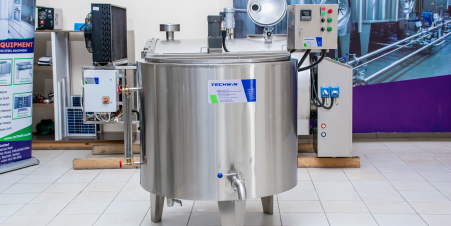
For dairy processors, cooperatives, and milk entrepreneurs, compliance begins with appropriate pasteurizer equipment capable of meeting legal temperature and hygiene requirements consistently. Manual or informal heating methods often fail to meet regulatory standards and expose businesses to rejection during inspection or testing.
Modern pasteurizer equipment enables businesses to:
• Meet Kenya's pasteurisation law requirements
• Improve milk safety and consistency
• Increase shelf life and reduce spoilage
• Access formal and institutional markets
• Protect their business from regulatory penalties
Investing in compliant pasteurisation systems is therefore both a legal necessity and a strategic business decision.
Compliance as a Competitive Advantage in Kenya’s Dairy Industry
Kenya’s mandatory pasteurisation requirements are not intended to limit dairy businesses, but to strengthen the industry through safer products, formal market integration, and consumer trust. Businesses that comply with the Dairy Industry (Dairy Produce Safety) Regulations, 2021 position themselves for sustainable growth in an increasingly regulated and quality-driven market.
Understanding the law, implementing compliant processing systems, and aligning operations with KDB and KEBS standards ensures dairy businesses remain legally protected, competitive, and ready to serve both local and institutional markets.
Contact us on +254743 793 878 to inquire about milk pasteurizers and processing equipment.